Ages 7–10 · 120 minutes · A free sample plan
A science-lab birthday with experiments kids can repeat
Plan a science afternoon for eight guests around things they can test themselves: a paper spinner, a bridge that carries a load, and a colour-matching challenge. Blue, purple and yellow paper gives the table a laboratory feel without glassware or specialist equipment. The interesting part is comparing attempts, not producing an impressive demonstration.
A little structure, with room to adapt.
Give each experiment time for a second attempt. Explain one variable at a time, then let pairs work at their own speed. Set aside a quieter seat for anyone who wants to observe first. An adult handles holes in card and keeps drinks away from the testing table.
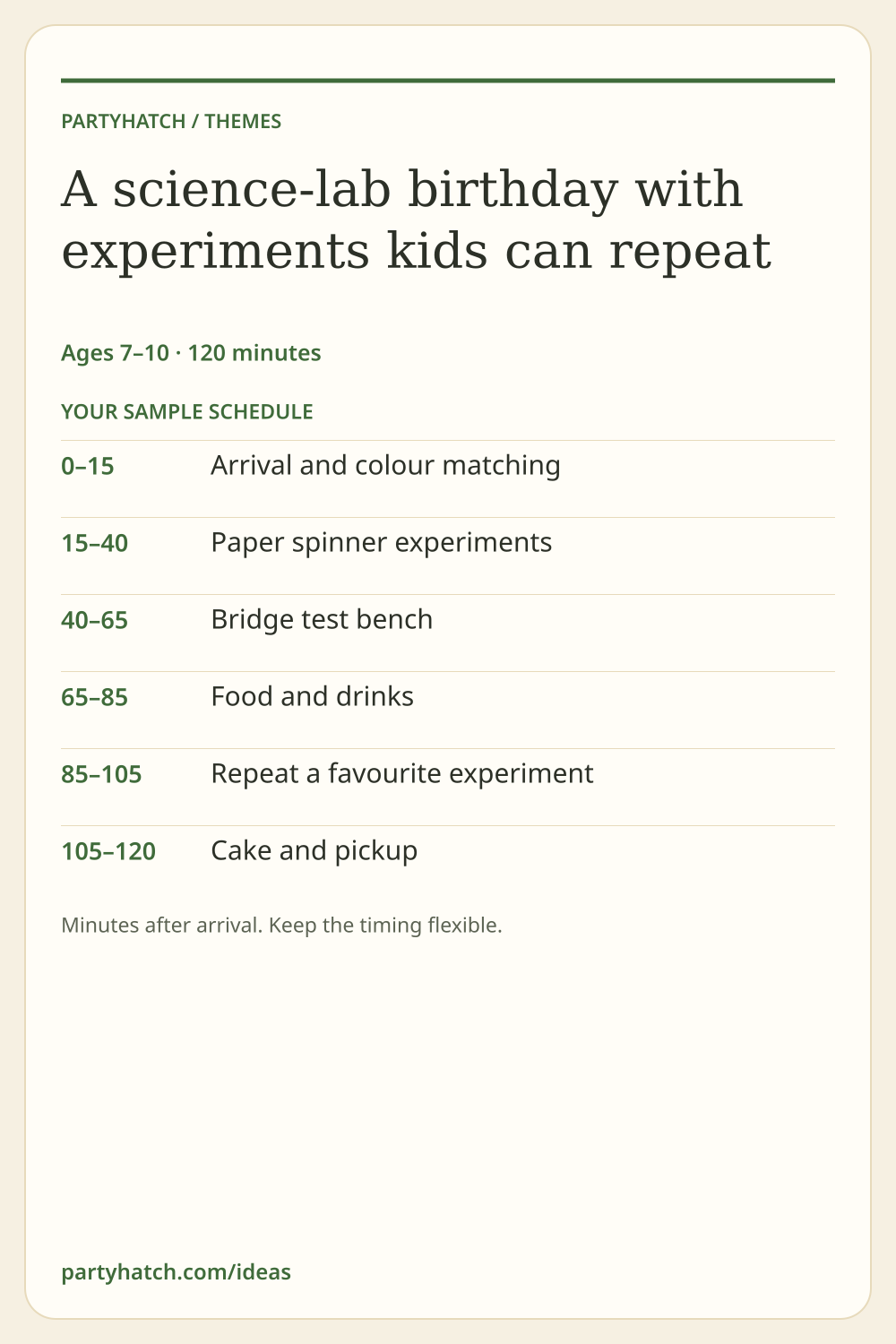
Times below are minutes after arrival. Adjust them to your guests and your space.
- 0–15Arrival and colour matching
- 15–40Paper spinner experiments
- 40–65Bridge test bench
- 65–85Food and drinks
- 85–105Repeat a favourite experiment
- 105–120Cake and pickup
How to run the activities
1. Paper spinner test bench
Gather: Eight 9 cm card discs, eight short pencils, coloured pens and a tray. An adult makes the centre holes.
- Draw eight wedges on each disc and colour them blue, purple and yellow. An adult fits a short pencil through the centre so only a short tip sits below the card.
- Spin on a tray. Compare a slow turn with a fast turn and describe what happens to the colours; guests can point or draw instead of explaining aloud.
- Change just one thing, such as the height of the disc on the pencil. Try again. Keep the disc and pencil separate for transport.
2. Bridge test bench
Gather: Sixteen A4 sheets, eight identical books, a ruler and large wooden blocks for supervised testing.
- Make four pairs of book supports, each 15 cm apart. Lay one sheet across each gap and predict how many blocks it will hold.
- Add one block at a time over the centre, keeping hands clear when the paper bends. Record the load before the bridge gives way.
- Fold a fresh sheet into an accordion and repeat with the same gap and blocks. Ask what changed and let pairs try a third shape.
3. Build a colour code
Gather: Eight sets of six large paper squares: two blue, two purple and two yellow.
- Lay out a four-square sequence where everyone can see it. Each pair builds the same sequence from their own pieces.
- Change the challenge: make a sequence that has yellow at both ends and two different colours in the middle. Accept every solution that fits.
- Let pairs invent a rule for another pair. Keep the pieces visible; this is a pattern challenge, not a speed test.
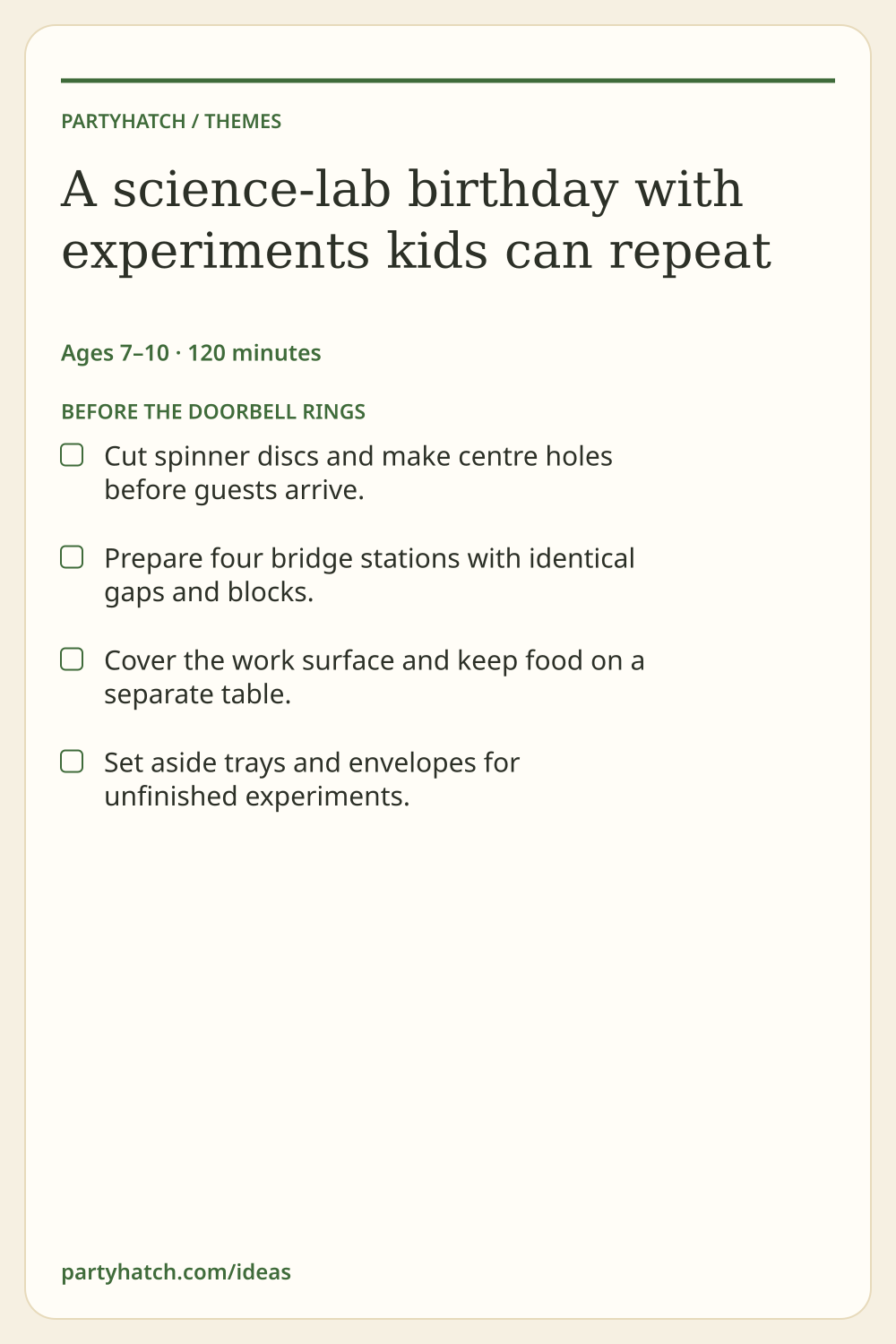
Before the doorbell rings
- Cut spinner discs and make centre holes before guests arrive.
- Prepare four bridge stations with identical gaps and blocks.
- Cover the work surface and keep food on a separate table.
- Set aside trays and envelopes for unfinished experiments.
Keep the cake achievable
Use a plain supermarket cake with blue, purple and yellow icing dots. Add paper atom toppers on food-safe picks and remove them before serving; keep craft chemicals and non-edible decorations off the cake.
If plans change
If a spinner is frustrating, try a larger disc with fewer colours. If space is tight, rotate two pairs at the bridge table while the others work on colour codes.
A little something to take home
Paper Spinner Science Kit
For eight guests: Eight card discs, eight short pencils, coloured markers shared at the table, paper bags and folded instruction cards.
- An adult cuts each disc and makes a centre hole. Divide the disc into eight wedges and decorate with blue, purple and yellow.
- Test the disc with its pencil spindle, then separate the pieces for packing. Include the spinner instructions from this guide on a folded card.
- Put one disc, one pencil and one card in each bag. Add a small label across the folded opening; shared markers stay at the party.
Build your own free party draft.
Start with Science Lab, then add your date, guests and space. Your draft and invitation are free. When you’re ready, unlock your full party plan for $15.
Build my free party draft →Save it for party day.
Keep the schedule or preparation card on your phone, or save it to Pinterest for later.